
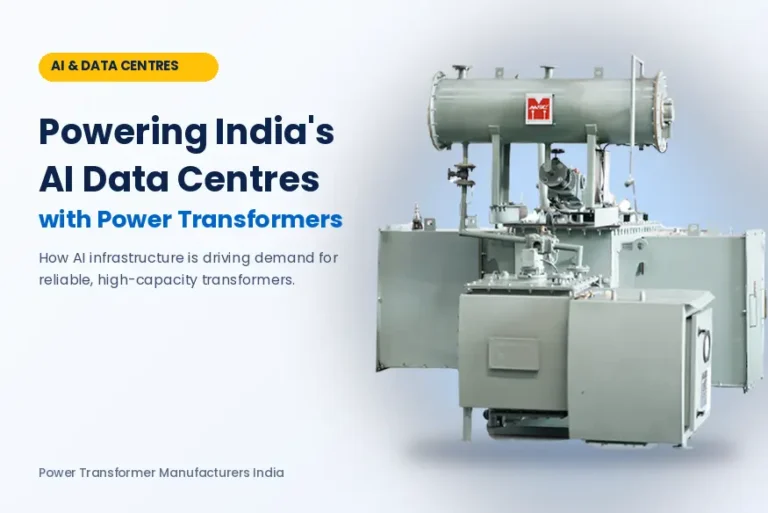
India’s digital infrastructure is expanding rapidly. From cloud computing and online services to artificial intelligence (AI), enterprise applications and digital payments, businesses are generating and processing more data than ever before.
This growth is creating a new requirement: reliable, high-capacity power infrastructure.
Data centres are among the most power-intensive facilities in the modern economy. They need continuous electricity to operate servers, cooling systems, networking equipment, backup systems and other critical infrastructure. As AI workloads become more demanding, the electrical load of these facilities is also increasing.
This is creating new opportunities for power transformer manufacturers in India, as transformers play an important role in converting, distributing and managing electrical power within large industrial and digital infrastructure projects.
For transformer manufacturers such as MSC Transformers, this changing demand highlights the importance of reliable transformer solutions that can support high-load applications and future power requirements.
Why Data Centres Need Reliable Power Infrastructure
A data centre cannot afford frequent power interruptions. Even a short disruption can affect servers, applications, cloud services and business operations.
For this reason, data centres typically use multiple layers of electrical infrastructure, including:
- Utility power connections
- High-voltage and medium-voltage systems
- Power transformers
- Distribution transformers
- Switchgear and protection systems
- UPS systems
- Diesel generators or other backup systems
- Cooling and HVAC systems
Among these components, transformers are essential because they help step electrical voltage up or down to the levels required by different parts of the facility.
As data centre capacity increases, the requirement for dependable transformer equipment becomes increasingly important.
How AI Is Increasing Data Centre Power Demand
Artificial intelligence is changing the scale of data centre infrastructure.
Traditional data centre workloads already require substantial computing power. AI workloads can require significantly more processing capacity because they rely on high-performance GPUs, accelerators and other specialised computing hardware.
AI infrastructure also generates considerable heat, which increases the demand for cooling systems. As a result, the overall electrical requirement of an AI-focused facility can be substantially higher than that of a conventional data centre.
The International Energy Agency expects global data centre electricity consumption to more than double by 2030, with AI being one of the major drivers of this growth.
For India, this creates a growing need for electrical infrastructure capable of supporting large and continuously operating facilities.
Why This Matters for Power Transformer Manufacturers in India
The expansion of data centres creates demand not only for servers and cooling equipment but also for the electrical infrastructure supporting them.
Power transformer manufacturers in India have an important role to play in this ecosystem.
Transformers used in large infrastructure projects need to be selected according to factors such as:
- Required power capacity
- Input and output voltage
- Load characteristics
- Cooling requirements
- Efficiency
- Installation environment
- Protection requirements
- Future expansion plans
- Reliability and maintenance requirements
A transformer is not simply selected based on its capacity. The complete electrical design and expected operating conditions need to be considered before finalising the specification.
This is where an experienced transformer manufacturer in India can add value during project planning and equipment selection.
Data Centre Expansion Is Creating New Transformer Requirements
Data centres are increasingly being developed as large-scale infrastructure projects rather than small server facilities.
The electrical architecture may need to accommodate multiple buildings, server halls, cooling plants, backup systems and future expansion.
This creates demand for transformer solutions that can be integrated into larger electrical distribution systems.
Depending on the project design, different transformer types may be considered for different applications.
For example, distribution transformers can support downstream electrical distribution, while power transformers may be used where higher voltage and larger power transfer requirements exist.
The selection depends on the electrical architecture and specifications of each project.
How MSC Transformers Can Support High-Load Infrastructure
This is where MSC Transformers fits into India’s growing electrical infrastructure landscape.
MSC Transformers is an established transformer manufacturing company in Maharashtra, serving industrial, commercial and utility applications. Its transformer portfolio includes power transformers, distribution transformers, hermetically sealed transformers, solar inverter duty transformers, furnace transformers and compact substations.
For data centres and other high-load infrastructure projects, the transformer requirement depends heavily on the project’s voltage, capacity, operating conditions and electrical distribution design.
MSC Transformers can work around these project requirements by understanding the application and providing transformer solutions aligned with the required electrical specifications.
Its manufacturing capabilities also extend beyond data centre applications, covering industrial facilities, renewable energy projects, manufacturing plants and other power-intensive applications.
This broader experience is important because data centre electrical infrastructure shares several requirements with other critical industrial applications, particularly the need for reliable power distribution and equipment designed for continuous operation.
What Should Data Centre Developers Consider When Selecting a Transformer?
Choosing the right transformer requires more than comparing capacity and price.
1. Transformer Capacity
The transformer should be appropriately sized for the expected electrical load.
Undersizing can create operational problems, while excessive oversizing can affect project economics and efficiency.
Data centre projects should also consider potential future expansion when determining transformer capacity.
2. Voltage Requirements
The transformer’s input and output voltage must match the electrical distribution architecture of the facility.
The required voltage ratio should therefore be established during the project’s electrical design stage.
3. Cooling Arrangement
Transformer cooling becomes important when equipment operates under high electrical loads.
The appropriate cooling arrangement depends on transformer design, capacity, installation conditions and operating requirements.
4. Efficiency
Energy efficiency is particularly important for data centres because these facilities operate continuously.
Even relatively small efficiency differences can become significant when equipment operates around the clock for years.
5. Reliability
Data centres support critical digital services, so electrical equipment needs to provide dependable performance.
Transformer quality, manufacturing standards, testing and maintenance support should therefore be considered during supplier selection.
6. Future Expansion
Data centre operators frequently plan capacity expansion as demand for computing resources grows.
The electrical infrastructure should therefore be planned with future requirements in mind wherever possible.
Why Choose an Experienced Transformer Manufacturing Company?
Selecting the right manufacturer can influence the long-term performance of a power infrastructure project.
An experienced transformer manufacturing company can help customers understand technical requirements, select an appropriate transformer configuration and coordinate equipment specifications with the broader electrical system.
Important factors to evaluate include:
- Manufacturing experience
- Product range
- Engineering capability
- Quality and testing processes
- Customisation capability
- Delivery capability
- Installation support
- Maintenance and after-sales service
For large industrial and infrastructure projects, these factors can be just as important as the initial equipment cost.
MSC Transformers: Supporting India’s Evolving Power Infrastructure
MSC Transformers is positioned to serve a broad range of transformer requirements across industrial and infrastructure applications.
Its portfolio includes:
- Power Transformers
- Distribution Transformers
- Hermetically Sealed Transformers
- Solar Inverter Duty Transformers
- Furnace Transformers
- Compact Substations
This range allows project teams to evaluate transformer solutions according to their specific electrical requirements rather than relying on a single standard configuration.
MSC Transformers is based in MIDC Jejuri, Pune, Maharashtra, giving it an established manufacturing presence in one of India’s major industrial regions.
The company has also supplied transformer solutions for applications across different sectors, including industrial and renewable-energy projects.
As India’s data centre ecosystem expands, the demand for dependable electrical infrastructure will continue to grow. Transformer manufacturers that combine engineering knowledge, manufacturing capability and application-focused support can play an important role in meeting this demand.
The Future of Data Centres and Transformers in India
India’s digital economy is expected to continue expanding, supported by cloud computing, AI, digital services, enterprise technology and data localisation.
As data centre capacity grows, electrical infrastructure will need to grow alongside it.
This means future projects will increasingly focus on:
- Higher electrical capacity
- Better energy efficiency
- Reliable power distribution
- Scalable infrastructure
- Improved cooling systems
- Renewable energy integration
- Greater electrical redundancy
- Long-term operational reliability
For power transformer manufacturers in India, this represents an important growth opportunity.
The transformer industry will not only support conventional power distribution but also the infrastructure behind India’s next generation of digital and AI-powered services.
Conclusion
The rapid growth of AI and data centres is changing India’s power infrastructure requirements.
As facilities become larger and computing loads increase, reliable transformers will remain an essential part of their electrical distribution systems.
For developers and engineering teams, selecting the right transformer manufacturer means looking beyond capacity and price. Manufacturing experience, engineering capability, product range, quality, reliability and long-term support should all be considered.
MSC Transformers brings its experience as a transformer manufacturing company in Maharashtra along with a broad portfolio covering power, distribution, hermetically sealed, solar inverter duty, furnace and other transformer applications.
As India’s digital infrastructure continues to expand, reliable transformer manufacturing will remain an important part of building the power systems needed to support it.
Planning a high-load industrial or infrastructure project? Contact MSC Transformers to discuss your transformer capacity, voltage and application requirements.
Frequently Asked Questions
Transformers are an important part of data centre electrical infrastructure because they help convert and distribute electrical power at the voltage levels required by different systems within the facility.
AI workloads require high-performance computing equipment that can significantly increase electricity consumption and cooling requirements. As AI data centres expand, their electrical infrastructure also needs to support higher and more complex loads.
Important factors include transformer capacity, voltage ratio, cooling arrangement, efficiency, reliability, installation conditions, future expansion requirements and the overall electrical design of the facility.
MSC Transformers manufactures a range of transformer solutions for industrial, commercial, utility and renewable-energy applications. The appropriate transformer can be selected based on the project’s capacity, voltage and application requirements.
MSC Transformers’ portfolio includes power transformers, distribution transformers, hermetically sealed transformers, solar inverter duty transformers, furnace transformers and compact substations.
MSC Transformers is located at MIDC Jejuri, Pune, Maharashtra, India, and serves transformer requirements across industrial and infrastructure applications.