
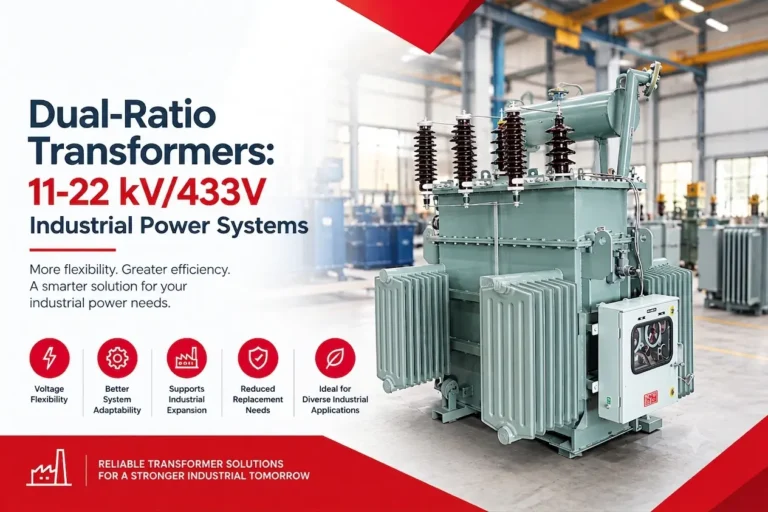
Introduction
Explain that industrial power systems increasingly need flexibility because facilities may operate with different incoming voltage levels or changing electrical requirements. Introduce dual-ratio transformers as a practical solution for applications requiring 11 kV and 22 kV compatibility.
What Are Dual-Ratio Transformers?
Explain the basic concept in simple terms:
- Designed to accommodate two specified primary voltage ratios
- Can support 11 kV and 22 kV systems
- Provide greater flexibility during system planning
- Useful where voltage requirements may change
- Can help reduce the need for completely different transformer configurations
Mention that the exact voltage ratio, winding arrangement and operating configuration depend on the transformer design and application.
Why Are 11-22 kV/433V Transformers Becoming Important?
Cover:
1. Greater voltage flexibility
Industrial facilities may have different incoming supply requirements.
2. Easier integration with changing power networks
A dual-ratio design can provide greater adaptability when electrical infrastructure evolves.
3. Better planning for industrial expansion
Businesses expanding their electrical load can benefit from equipment designed with future requirements in mind.
4. Reduced equipment replacement requirements
Where technically appropriate, a flexible transformer configuration can reduce the need to replace equipment simply because the supply voltage changes.
5. Suitable for diverse industrial applications
Discuss manufacturing plants, MIDC industrial facilities, infrastructure projects, renewable-energy-linked systems and other heavy electrical applications.
How Does an 11-22 kV/433V Transformer Work?
Explain the primary and secondary sides, voltage ratio, winding configuration and how the required voltage connection is selected.
Keep this technical enough for engineers but understandable for procurement and plant-management teams.
Key Benefits of Dual-Ratio Transformers
Use bullets:
- Voltage flexibility
- Improved system adaptability
- Better infrastructure planning
- Potentially lower replacement costs
- Suitable for changing industrial requirements
- Efficient integration into planned electrical systems
- Customizable according to project requirements
Applications of 11-22 kV/433V Transformers
Include:
- Manufacturing plants
- Industrial estates and MIDC facilities
- Process industries
- Infrastructure projects
- Utility-linked industrial systems
- Renewable-energy installations
- Large commercial and industrial facilities
What Should You Consider Before Choosing a Dual-Ratio Transformer?
Discuss:
- Primary voltage requirements
- Secondary voltage
- Transformer capacity
- Load characteristics
- Frequency
- Vector group
- Impedance
- Cooling method
- Installation environment
- Protection requirements
- Applicable standards
- Future expansion requirements
This section is particularly useful for attracting industrial buyers and engineers, rather than making the article purely informational.
Why Choose the Right Transformer Manufacturer?
Here you can naturally introduce MSC Transformers Pvt Ltd.
Mention that selecting a transformer manufacturer should involve more than comparing price. Buyers should evaluate manufacturing capability, engineering support, testing, customization, delivery capability and after-sales service.
Then position MSC Transformers as a Pune/Maharashtra-based transformer manufacturer offering customized transformer solutions for industrial requirements.
You can mention its dual-ratio 11/22 kV to 0.433 kV transformer capability here, provided that this specification is confirmed on the current product documentation.
Conclusion
Bring the article back to the main point: dual-ratio transformers can provide greater flexibility for industrial electrical systems where 11 kV and 22 kV requirements need to be accommodated. The right design should be selected based on load, voltage, capacity, installation conditions and future requirements.
Frequently Asked Question
A dual-ratio transformer is designed to operate with two specified primary voltage ratios, providing greater flexibility for electrical systems with different voltage requirements.
An 11/22 kV transformer is designed to accommodate either an 11 kV or 22 kV primary voltage configuration, depending on its specific design and application.
They can be used in manufacturing plants, industrial facilities, infrastructure projects, utilities and other applications where flexible medium-voltage power distribution is required.
Capacity, primary and secondary voltage, load profile, impedance, vector group, cooling method, installation conditions, protection requirements and future expansion should all be evaluated.
They can provide additional voltage flexibility, but suitability for future expansion depends on the transformer's specific design, capacity and electrical system requirements.
A reliable manufacturer can help with transformer design, customization, testing, installation support and after-sales service, helping ensure the transformer matches the project's electrical requirements.