
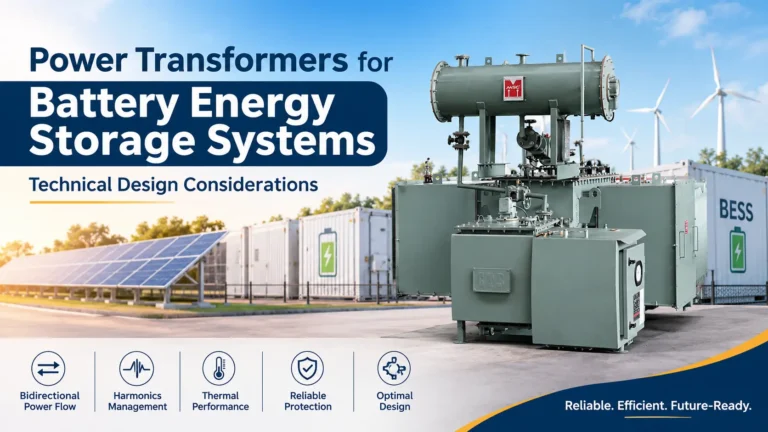
The growing adoption of renewable energy and the need for reliable electricity supply are accelerating the deployment of Battery Energy Storage Systems (BESS). These systems store electricity and release it when required, helping balance supply and demand, support grid stability and improve the utilisation of renewable energy.
However, integrating a BESS into an electrical network requires more than selecting suitable batteries and power conversion equipment. The transformer is another critical component because it connects the energy storage system to the facility’s electrical network or the utility grid.
Power transformers for battery energy storage systems must be designed to handle changing operating conditions, bidirectional power flow, harmonic distortion and varying load profiles. Their electrical characteristics, thermal performance, insulation system and protection arrangements must align with the requirements of the complete energy storage installation.
For project developers, EPC contractors and electrical consultants, understanding these design considerations is essential for achieving reliable and efficient BESS operation.
The growing demand for renewable energy integration has increased the importance of Power Transformers for Battery Energy Storage Systems, which help ensure efficient electricity transfer and stable grid connectivity.
Selecting the right power transformers for battery energy storage systems is essential for maintaining electrical stability, managing changing load conditions and ensuring efficient energy transfer between the grid and battery storage infrastructure.
Understanding the Role of Power Transformers in Battery Energy Storage Systems
A Battery Energy Storage System typically consists of battery modules, a Battery Management System (BMS), a Power Conversion System (PCS), control equipment and associated electrical infrastructure.
The PCS converts DC power from the batteries into AC power during discharge. During charging, it converts AC power from the grid or another source into DC power for battery storage.
The transformer provides the required voltage interface between the PCS and the connected electrical network. Depending on the project architecture, it may step up the voltage for grid connection or provide an appropriate voltage level for the BESS installation.
The main functions of a BESS transformer include:
- Voltage transformation: Matching the PCS output voltage with the required grid or facility voltage.
- Electrical isolation: Providing isolation between connected electrical systems where required by the selected transformer configuration.
- Power transfer: Supporting energy transfer during both charging and discharging operations.
- Grid integration: Connecting the storage system to the distribution or transmission network.
- Operational reliability: Supporting stable performance under changing electrical and environmental conditions.
The transformer specification must therefore be developed in coordination with the PCS, battery system, grid connection requirements and project operating strategy.
The design of power transformers for battery energy storage systems must account for the electrical interface between the Power Conversion System and the grid, ensuring compatibility with the overall BESS architecture.
Key Design Considerations for Power Transformers for Battery Energy Storage Systems
Selecting power transformers for battery energy storage systems requires an understanding of the electrical and operational conditions under which the equipment will operate. The following factors deserve particular attention during transformer specification and engineering.
1. Transformer Rating and Capacity Selection
Transformer capacity is one of the first considerations in BESS project planning. The rating must accommodate the expected charging and discharging power without exceeding its specified operating limits.
The required capacity depends on several factors, including:
- Rated active power of the PCS
- Power factor and reactive power requirements
- PCS efficiency and operating characteristics
- Charging and discharging duration
- Ambient temperature and installation conditions
- Expected load profile and operating duty
- Future expansion requirements
For example, a BESS installation designed for frequent high-power charging and discharging may impose a different operating duty from a system used primarily for occasional backup power.
Transformer capacity should not be selected solely based on the battery’s energy capacity in MWh. The power rating in MW, PCS characteristics and expected operating conditions must also be considered.
An appropriately rated transformer helps prevent unnecessary thermal stress while supporting the required power transfer.
Proper capacity planning is a fundamental requirement when selecting power transformers for battery energy storage systems, as it directly influences operational efficiency, loading capability and long-term equipment reliability.
2. Managing Bidirectional Power Flow
One of the defining characteristics of a Battery Energy Storage System is its ability to both absorb and supply electrical energy.
During charging, electrical power flows from the grid towards the battery system. During discharging, the stored energy is converted into AC power and transferred back towards the grid or connected load.
This bidirectional operation makes the transformer specification particularly important.
The transformer must be suitable for the intended power flow in both directions. Its voltage regulation, impedance, winding arrangement and thermal performance should be evaluated against the project’s charging and discharging operating conditions.
Engineers should also consider:
- Maximum charging and discharging power
- Expected duration of each operating cycle
- Changes in power factor
- Reactive power exchange
- Voltage variations at the point of connection
- Protection coordination during different operating modes
A transformer designed around only one direction of power transfer may not adequately represent the complete operating requirements of a BESS installation.
Therefore, power transformers for battery energy storage systems should be engineered to support the specified charging and discharging cycles while maintaining suitable electrical and thermal performance.
3. Harmonic Distortion and Power Quality
Power Conversion Systems use semiconductor-based switching devices to convert electrical power between AC and DC. These switching operations can introduce harmonic currents and voltage distortion into the electrical network.
The level of harmonic distortion depends on the converter topology, switching frequency, control strategy, filtering arrangements and operating conditions.
Harmonic currents can increase additional losses in transformer windings and structural components. Depending on their magnitude and frequency, they may also contribute to localised heating and affect transformer efficiency.
When specifying a BESS transformer, engineers should evaluate:
- Expected harmonic current spectrum
- Total Harmonic Distortion (THD)
- Transformer winding losses
- Eddy current and stray losses
- Temperature rise under non-sinusoidal loading
- Harmonic filtering and mitigation arrangements
The transformer specification should be based on the actual harmonic data provided by the PCS manufacturer wherever possible.
In applications with significant harmonic content, additional engineering evaluation may be required to establish the appropriate transformer design and thermal capability.
Considering transformer harmonics during the design stage helps ensure that power transformers for battery energy storage systems can operate reliably under the expected power conversion conditions.
4. Thermal Performance and Cooling Requirements
Battery Energy Storage Systems can operate through repeated charging and discharging cycles. These operating patterns can create changing transformer loading conditions.
Transformer temperature is influenced by winding losses, core losses, ambient temperature, cooling arrangements and the duration of loading.
Continuous high loading, frequent load variations and harmonic-related additional losses can increase thermal stress. Excessive operating temperatures may accelerate insulation ageing and affect the expected service life of the transformer.
Important thermal design considerations include:
- Maximum continuous operating load
- Expected load cycle and overload duration
- Ambient temperature at the installation site
- Cooling method and available ventilation
- Winding temperature rise
- Harmonic-related additional losses
- Temperature monitoring and alarm arrangements
The cooling system must be suitable for the transformer’s rating and specified operating environment. Depending on the application, ONAN or other appropriate cooling arrangements may be considered based on the required capacity and design conditions.
Thermal performance should be assessed using the expected operating profile rather than relying only on the nominal transformer rating.
Effective thermal management is particularly important for power transformers for battery energy storage systems, where repeated charging and discharging cycles can create varying loading and temperature conditions.
5. Voltage Regulation and Transformer Impedance
Voltage stability is an important requirement for grid-connected energy storage systems.
During charging and discharging, the direction and magnitude of power flow change. These variations can influence voltage at the transformer terminals and the point of common coupling.
Transformer impedance affects voltage drop, voltage regulation and fault current levels. Therefore, selecting an appropriate impedance value is important for both normal operation and protection coordination.
Engineers should evaluate:
- Primary and secondary voltage requirements
- Transformer impedance
- Voltage variation during charging and discharging
- Grid short-circuit level
- PCS voltage operating range
- Voltage regulation requirements
- Coordination with other connected transformers and equipment
The impedance value should be selected in coordination with the grid connection study and the electrical characteristics of the PCS.
Where voltage regulation requirements are demanding, the project may also need an appropriate tap-changing arrangement. The selection depends on the network design and operating philosophy.
6. Insulation System and Dielectric Strength
The insulation system plays a major role in transformer reliability. It must withstand the electrical stresses associated with normal operation, switching events and specified abnormal conditions.
For BESS applications, the insulation system should be evaluated against the transformer’s voltage class, winding configuration, operating temperature and installation environment.
Key considerations include:
- Rated system voltage
- Basic insulation level (BIL), where applicable
- Lightning and switching impulse withstand requirements
- Winding insulation arrangement
- Insulating oil or other insulation medium
- Temperature-related insulation ageing
- Environmental and operating conditions
The insulation coordination study should establish the appropriate dielectric requirements for the installation.
Selecting an insulation system suited to the electrical and thermal operating conditions helps support long-term transformer performance.
7. Protection and Monitoring Requirements
Protection systems help identify abnormal operating conditions and isolate faults before they cause extensive equipment damage.
In a BESS installation, transformer protection must be coordinated with the PCS, battery protection system, switchgear and grid protection scheme.
Depending on the transformer design and application, protection may include:
- Differential protection
- Overcurrent and earth-fault protection
- Restricted earth-fault protection, where applicable
- Winding and oil temperature monitoring
- Buchholz protection for applicable oil-filled transformer designs
- Pressure relief arrangements
- Surge protection
- Electrical interlocking and trip coordination
Monitoring systems can also provide useful information about operating conditions, temperature trends and equipment performance.
The final protection arrangement should be determined through the project’s protection coordination study and applicable standards.
Power Transformer Design Challenges in Grid-Connected BESS Installations
Grid-connected BESS installations can operate under different power dispatch strategies. These may include peak shaving, frequency regulation, renewable energy integration, backup power and energy arbitrage.
Each application can create a different transformer loading pattern.
For example, a system used for frequency regulation may experience frequent power variations, while a system used for renewable energy shifting may follow more predictable charging and discharging schedules.
This makes it important to understand the complete operating profile before finalising the transformer specification.
Other project-level challenges include:
Grid fault levels: The transformer must have suitable short-circuit withstand capability based on the network fault study.
Parallel operation: Where multiple transformers operate in parallel, their voltage ratios, impedance, vector groups and other relevant characteristics must be coordinated.
Environmental conditions: Outdoor installations may require consideration of temperature, humidity, dust, corrosion and other site-specific factors.
System expansion: Future BESS capacity additions should be considered during initial electrical planning to avoid unnecessary equipment limitations.
A well-developed transformer specification helps address these challenges before manufacturing and installation.
How to Select the Right Transformer for a Battery Energy Storage Project
Choosing the appropriate transformer requires coordination between the BESS developer, EPC contractor, PCS supplier, electrical consultant and transformer manufacturer.
Before finalising power transformers for battery energy storage systems, project developers should evaluate the complete electrical requirements, including PCS compatibility, voltage levels, impedance, harmonic loading and cooling arrangements.
Before finalising the transformer design, project teams should establish the following information:
- PCS technical specifications: Obtain rated power, AC voltage, power factor range, harmonic data and operating limits.
- Grid connection requirements: Confirm grid voltage, frequency, fault level and applicable utility requirements.
- Operating profile: Define charging and discharging power, cycle frequency, operating duration and expected load variations.
- Transformer rating: Determine the required capacity based on the complete electrical operating conditions.
- Impedance and voltage regulation: Establish suitable values through system studies.
- Thermal and cooling requirements: Evaluate ambient conditions, expected losses and loading patterns.
- Protection and monitoring: Coordinate transformer protection with the PCS and overall BESS control system.
- Applicable standards: Confirm the relevant IEC, IS and utility requirements for the project.
Working with an experienced transformer manufacturing company in India can help project teams translate these technical requirements into a suitable transformer specification.
How MSC Transformers Supports Power Transformer Requirements
Transformer selection is an important part of developing a reliable Battery Energy Storage System. The manufacturing partner must understand the electrical requirements, operating conditions and project-specific technical specifications.
MSC Transformers, established in 2013, is a transformer manufacturer based in Pune, India. The company focuses on transformer manufacturing for industrial and power applications.
Its technical capabilities include distribution transformers across a 100–20,000 kVA range and solar inverter duty transformer configurations up to 10 MVA, with up to five windings and voltage configurations extending to 33 kV on the secondary side, as specified for its product range.
These capabilities are relevant to renewable energy and power conversion applications where transformer voltage, winding configuration and electrical performance must be aligned with the connected system.
For BESS-related projects, MSC Transformers can engage with project teams to understand requirements such as:
- Required transformer capacity and voltage ratio
- PCS output characteristics
- Winding configuration
- Impedance and short-circuit requirements
- Harmonic loading considerations
- Cooling and temperature-rise requirements
- Protection and monitoring provisions
- Site and installation conditions
The final transformer design and suitability must be established against the project’s technical specifications and applicable standards.
As one of the transformer manufacturers in Pune serving industrial and power-sector requirements, MSC Transformers aims to support customers with application-oriented transformer solutions.
Whether a project requires a power transformer, distribution transformer or solar inverter duty transformer, selecting the right manufacturing partner starts with a clear understanding of the electrical system and its operating requirements.
MSC Transformers understands the importance of application-specific engineering when evaluating power transformers for battery energy storage systems and related renewable energy applications
Planning a Battery Energy Storage System or renewable energy project? Connect with MSC Transformers to discuss your transformer requirements.
Conclusion
Battery Energy Storage Systems are becoming an important part of modern power networks, supporting renewable energy integration, grid balancing and reliable electricity supply.
However, their performance depends on the compatibility of every major electrical component, including the transformer.
Power transformers for battery energy storage systems must be evaluated for capacity, bidirectional power flow, harmonic distortion, thermal performance, voltage regulation, insulation strength and protection coordination.
A properly specified transformer helps support reliable energy transfer and stable operation throughout the intended charging and discharging cycles.
For project developers and EPC contractors, involving the transformer manufacturer early in the engineering process can help identify technical requirements and avoid specification gaps.
MSC Transformers brings transformer manufacturing experience and relevant industrial and inverter-duty transformer capabilities to project discussions involving renewable energy and power applications.
Frequently Asked Questions
A transformer connects the Power Conversion System (PCS) of a BESS to the electrical network. It provides the required voltage transformation and supports power transfer during battery charging and discharging.
A BESS both receives electricity during charging and supplies electricity during discharging. The transformer must be suitable for the intended power flow in both directions and meet the associated voltage, thermal and electrical requirements.
Harmonics generated by power electronic converters can increase additional winding and structural losses. These losses may cause higher temperatures and additional thermal stress, making harmonic assessment important during transformer specification.
Transformer capacity is determined using the PCS power rating, voltage requirements, power factor, operating profile, harmonic characteristics, ambient conditions and expected loading. Battery energy capacity alone is not sufficient to determine transformer rating.
A solar inverter duty transformer may be suitable for certain BESS applications, but suitability depends on the PCS output, voltage ratio, winding configuration, harmonic characteristics, bidirectional operating requirements and project specifications. The design must be evaluated for the actual application.
Consider the manufacturer's engineering capabilities, transformer rating range, voltage and winding configurations, thermal design, short-circuit withstand capability, quality processes, testing facilities and ability to meet project-specific technical requirements.