
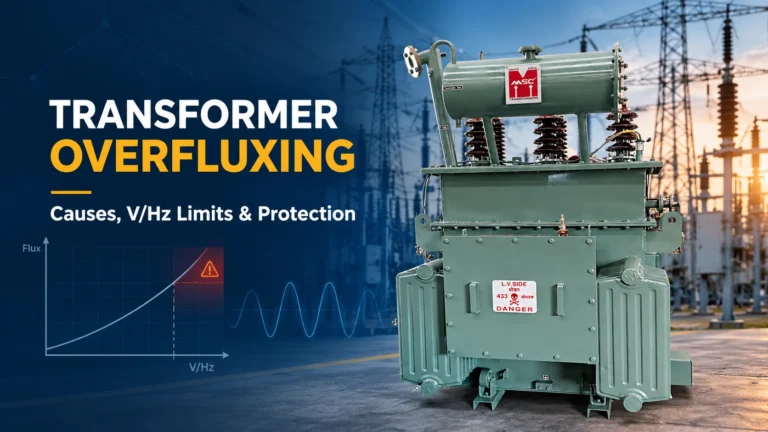
Transformers are designed to operate within specific voltage and frequency limits to maintain stable magnetic flux inside the core. When the applied voltage becomes too high for the operating frequency, or the frequency drops while voltage remains constant, the magnetic flux can exceed the design limit. This condition is known as transformer overfluxing, also called overexcitation.
Overfluxing can increase magnetising current, cause core saturation, increase stray losses, and create excessive heating in certain transformer components. For industrial facilities, substations, and power-generation systems, understanding this condition is essential for reliable transformer operation.
What Is Transformer Overfluxing?
Transformer overfluxing occurs when the magnetic flux in the transformer core exceeds its intended operating level. In a transformer operating with approximately sinusoidal voltage, the core flux is broadly proportional to the applied voltage divided by the supply frequency.
This relationship is commonly expressed as:
Magnetic flux ∝ Voltage / Frequency (V/f)
For a given transformer winding and number of turns, an increase in voltage or a decrease in frequency can raise the magnetic flux.
For example, if a transformer designed for a particular voltage and frequency operates at the same voltage but at a lower frequency, the V/Hz ratio increases. This may push the core beyond its intended magnetic operating range.
The permissible V/Hz limit depends on the transformer design, operating conditions, and manufacturer specifications. It should not be assumed to be identical for every transformer.
What Causes Transformer Overfluxing?
1. Excessive Applied Voltage
When the applied voltage exceeds the intended value while frequency remains unchanged, the magnetic flux increases. If the voltage rises beyond the transformer’s specified operating limits, overexcitation may occur.
This can happen because of incorrect voltage control, system operating conditions, or unsuitable settings in voltage-regulation equipment.
2. Reduced Operating Frequency
A reduction in supply frequency can increase the V/Hz ratio even when the applied voltage remains constant.
This is particularly important in power-generation applications, where transformer excitation conditions may change during abnormal generator operation or frequency disturbances.
3. Incorrect Voltage-to-Frequency Conditions
Transformers must operate within the voltage-frequency envelope specified for their design. Operating a transformer at a voltage appropriate for one frequency but at a lower frequency may result in excessive flux.
Engineers must therefore evaluate voltage and frequency together rather than treating them as independent operating parameters.
4. Improper Control or Protection Settings
Incorrect voltage-regulator settings, inadequate monitoring, or unsuitable protection thresholds can allow excessive excitation conditions to persist.
Protection settings should be coordinated with the transformer’s specified V/Hz capability and the operating requirements of the electrical system.
How Transformer Overfluxing Affects Core Performance
Core Saturation and Increased Magnetising Current
As magnetic flux approaches the core’s saturation region, a relatively small increase in flux can require a substantial increase in magnetising current.
This can increase electrical stress on the transformer and affect the performance of connected protection systems. The current waveform may also become distorted when the core operates in saturation.
Increased Core and Stray Losses
Overfluxing can increase core losses and stray losses in structural components, depending on the magnetic design and operating condition.
Higher losses mean more heat must be removed by the transformer’s cooling system. The location and magnitude of heating depend on the transformer construction and the severity and duration of overexcitation.
Localised Heating
Excessive flux can increase heating in parts of the magnetic circuit and nearby metallic structures. Localised temperature rise may occur even when the average temperature does not immediately indicate a serious problem.
Sustained operation outside the specified V/Hz limits can therefore affect insulation ageing and overall transformer reliability.
Noise and Vibration
Changes in magnetic operating conditions can increase magnetostriction-related vibration and audible noise. However, noise alone is not a reliable indicator of overfluxing because mechanical vibration, loose components, and other operating conditions can produce similar symptoms.
What Is V/Hz Protection in a Transformer?
V/Hz protection is designed to detect excessive voltage-to-frequency conditions that may result in transformer overexcitation.
The protection function evaluates the relationship between measured voltage and frequency and compares it with configured operating limits.
If the V/Hz ratio exceeds the specified threshold for a defined duration, the protection system may initiate an alarm or trip, depending on the protection philosophy and the severity of the condition.
How V/Hz Protection Works
A typical protection arrangement includes:
- Voltage measurement: The protection relay receives voltage signals from the appropriate instrument transformers or measurement circuits.
- Frequency measurement: The relay determines the system frequency or uses its implemented measurement method.
- V/Hz calculation: The relay evaluates the voltage-to-frequency ratio against configured thresholds.
- Time coordination: Alarm and trip delays are selected to distinguish permissible temporary conditions from damaging overexcitation.
- Protection action: The relay issues the specified alarm or trip command when the configured operating criteria are met.
Actual implementation varies by relay and application. Settings must follow the transformer’s excitation capability, relay manufacturer’s instructions, and the project’s protection-coordination requirements.
How to Prevent Transformer Overfluxing
Maintain Correct Voltage and Frequency
Operate the transformer within the specified voltage and frequency range. Investigate abnormal supply conditions promptly and verify that voltage-control systems are functioning correctly.
Configure Protection According to Design Limits
V/Hz alarm and trip settings should be based on the transformer’s documented capability rather than generic values. Coordination is especially important when the transformer is connected to generators or systems subject to frequency variations.
Monitor Operating Conditions
Monitoring voltage, frequency, loading, and relevant temperature indicators can help identify abnormal operating conditions. Where available, event records from protection relays can support investigation of overexcitation incidents.
Follow Manufacturer Recommendations
Transformer designs differ in core construction, magnetic operating limits, cooling arrangements, and permitted operating duration under abnormal conditions.
A qualified transformer manufacturer in India should provide the technical information needed to assess the transformer’s specified operating limits and intended application.
Investigate Repeated Protection Alarms
Repeated V/Hz alarms should not be ignored or resolved simply by increasing protection thresholds. The cause may involve voltage regulation, system frequency, measurement circuits, or incorrect settings. A qualified protection engineer should investigate the event before making changes.
Why Overfluxing Protection Matters in Industrial and Power Systems
Transformers used in substations, industrial plants, and power-generation systems may encounter changing operating conditions during switching, disturbances, or system recovery.
Effective overfluxing protection helps prevent excessive magnetic excitation from continuing beyond the transformer’s permitted operating limits. It also supports better coordination between transformer design, voltage regulation, and electrical protection.
When evaluating equipment from power transformer manufacturers India, project teams should consider the transformer’s rated voltage and frequency, specified V/Hz capability, protection requirements, and operating environment.
Selecting a suitable transformer involves more than checking the kVA or MVA rating. The electrical system and its operating conditions must also be considered.
Conclusion
Transformer overfluxing occurs when the magnetic flux exceeds the intended operating range, typically because the voltage-to-frequency ratio becomes too high. It can lead to core saturation, increased magnetising current, additional losses, and excessive heating.
Maintaining suitable voltage and frequency conditions, configuring V/Hz protection correctly, and following manufacturer specifications are essential measures for reducing the risk.
MSC Transformers provides transformer solutions for industrial and power-distribution applications. For project-specific requirements, consult the manufacturer and protection engineer to confirm the appropriate technical specifications and operating limits.
Planning a transformer installation or upgrade? Contact MSC Transformers to discuss your capacity, voltage, application, and technical requirements.
Frequently Asked Questions
Transformer overfluxing is a condition in which magnetic flux in the core exceeds its intended operating level, generally due to an excessive voltage-to-frequency ratio.
Common causes include excessive applied voltage, reduced operating frequency, unsuitable voltage-frequency conditions, and incorrect control or protection settings.
For a given winding under approximately sinusoidal operating conditions, magnetic flux is proportional to voltage divided by frequency. An increase in V/Hz can increase core flux.
It can cause core saturation, increased magnetising current, additional losses, localised heating, and increased thermal stress if the condition persists beyond the design limits.
V/Hz protection detects excessive voltage-to-frequency conditions and initiates an alarm or trip according to configured thresholds and time delays.
Only within the limits and duration specified for that particular transformer. Permissible operation depends on the design, operating conditions, and manufacturer documentation.