
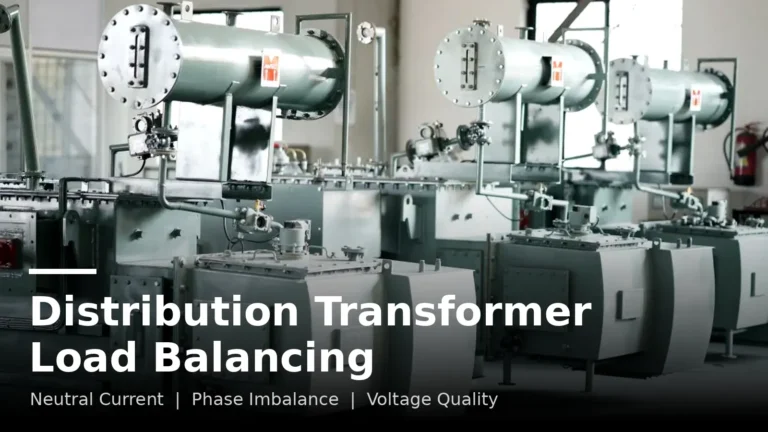
Distribution transformers supply electrical power to residential areas, commercial buildings, industrial facilities, and mixed-use networks. In three-phase systems, the distribution of connected loads across the phases directly affects current flow, voltage quality, and equipment performance. Distribution transformer load balancing is therefore an important part of reliable electrical network operation.
When single-phase loads are unevenly distributed, one phase may carry significantly more current than another. This imbalance can increase losses, contribute to voltage differences, and create additional stress on parts of the distribution system.
For electrical contractors, utilities, and businesses evaluating distribution transformer manufacturers in India, understanding phase loading is essential to selecting and operating equipment appropriately.
What Is Load Balancing in a Distribution Transformer?
Load balancing refers to distributing electrical demand as evenly as practical across the phases of a three-phase supply.
For example, a distribution network may supply lighting, small motors, office equipment, commercial appliances, and other loads. If too many single-phase loads are connected to one phase, that phase may carry considerably more current than the others.
Balanced loading does not mean every connected device must consume identical power. Instead, the goal is to achieve a suitable distribution of total phase currents while accounting for load type, operating patterns, and power factor.
The acceptable degree of imbalance depends on the network design, equipment specifications, and applicable utility requirements.
How Phase Imbalance Affects Transformer Performance
1. Unequal Phase Currents
When the loads connected to each phase differ, the phase currents also differ. The heavily loaded phase may experience greater copper losses because winding losses are proportional to the square of current.
For a given winding resistance, the relationship is:
Copper loss = I²R
This means a rise in current can increase losses disproportionately. However, the actual effect on total transformer losses depends on all phase currents, winding configuration, and operating conditions.
2. Voltage Imbalance and Voltage Drop
Uneven phase loading can contribute to unequal voltage drops across the distribution network. The effect depends on conductor impedance, transformer impedance, upstream supply conditions, and the characteristics of connected loads.
Sensitive equipment, three-phase motors, and industrial control systems may be affected by voltage imbalance. Motor performance and heating can be particularly sensitive to unequal phase voltages.
Load balancing can help, but it does not replace investigation of cable sizing, connections, supply quality, or other network issues.
3. Neutral Current
In a four-wire distribution system supplying single-phase loads, the neutral current is determined by the vector sum of the phase currents.
Under an ideal balanced condition with linear loads, the fundamental-frequency phase currents cancel in the neutral. Under unbalanced loading, the cancellation is incomplete and neutral current flows.
Non-linear loads, such as certain electronic power supplies and lighting equipment, can also produce harmonic currents. Triplen harmonics, including the third harmonic, may add in the neutral of a three-phase four-wire system rather than cancel in the same way as balanced fundamental-frequency currents.
Neutral conductor sizing and thermal performance must therefore consider the expected load mix and harmonic content.
Common Causes of Distribution Transformer Load Imbalance
Load imbalance may result from:
- Too many single-phase consumers connected to one phase.
- New connections added without reviewing existing phase loading.
- Uneven operating schedules across commercial or industrial loads.
- Seasonal changes in electricity demand.
- Faulty connections or issues with conductors and equipment.
- Non-linear loads that change current waveforms and harmonic levels.
A current measurement taken at a single moment may not represent the full operating pattern. Load assessment should consider variations across relevant operating periods.
How to Improve Distribution Transformer Load Balancing
Measure Phase Currents
Measure current on each phase under representative operating conditions. Where demand varies throughout the day, logging equipment can help identify recurring periods of imbalance.
Review Single-Phase Load Allocation
Where the network design permits, redistribute suitable single-phase loads among phases. Changes should be planned and performed by qualified electrical personnel, with attention to circuit protection and safe working procedures.
Monitor Neutral Current and Harmonics
If neutral current is unexpectedly high, assess phase imbalance, load types, harmonic content, and neutral connections. Neutral current alone does not identify the cause.
Check Voltage Quality
Measure phase-to-phase and phase-to-neutral voltages as applicable. Compare readings with the system’s specified limits and investigate whether the cause lies in load distribution, conductor impedance, transformer characteristics, or the upstream supply.
Plan for Future Demand
New equipment, production lines, EV charging, and other additional loads can change the phase-loading pattern. Periodic review helps ensure that distribution arrangements remain suitable as demand grows.
Selecting a Distribution Transformer for the Application
Load balancing is primarily a network-design and operational practice; it cannot compensate for an incorrectly sized transformer or inadequate distribution infrastructure.
When evaluating a distribution transformer supplier, buyers should consider rated capacity, primary and secondary voltage, impedance, cooling method, environmental conditions, expected load profile, and applicable standards.
Businesses comparing distribution transformer manufacturers should also review technical documentation and ensure the proposed equipment matches the project’s electrical requirements. For projects in western India, buyers may also compare transformer manufacturers in Maharashtra based on technical suitability, manufacturing capability, and service requirements.
Conclusion
Distribution transformer load balancing helps manage phase currents, reduce avoidable losses, and support better voltage quality. Effective management requires current measurement, appropriate load allocation, neutral and harmonic assessment, and periodic review as demand changes.
MSC Transformers supplies transformer solutions for power-distribution and industrial applications. The right transformer selection should be based on the project’s electrical specifications and operating conditions.
Planning a distribution network or transformer upgrade? Contact MSC Transformers to discuss the required capacity, voltage levels, and application.
Frequently Asked Questions
It is the practice of distributing electrical demand across the three phases as evenly as practical to support reliable operation.
It can increase losses in heavily loaded phases because winding copper losses rise with the square of current. Total losses depend on the actual phase currents and transformer design.
In a four-wire system, unequal phase currents do not fully cancel. Harmonic currents from non-linear loads can also contribute to neutral current.
Not by itself. A larger transformer may provide more capacity, but phase allocation and the causes of imbalance still need to be addressed.
The appropriate frequency depends on the installation and changes in demand. Measurements are especially useful after major load additions or when voltage-quality issues appear.