
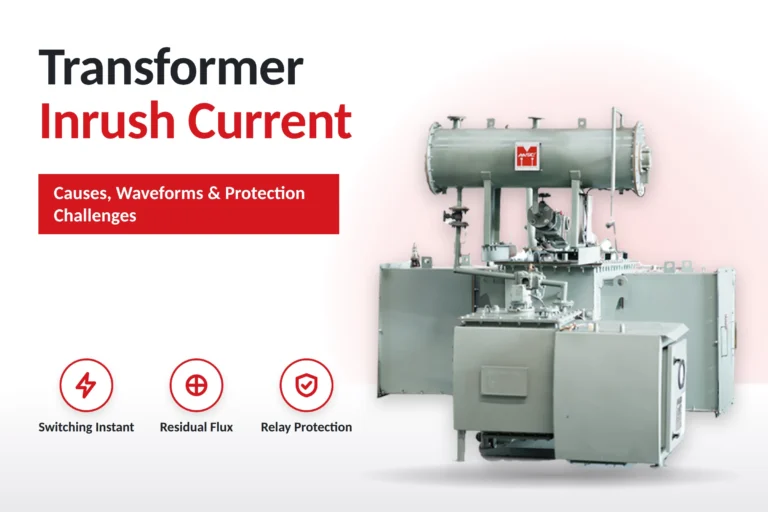
When a transformer is energised, the current drawn from the electrical supply can temporarily rise far above its normal magnetising current. This phenomenon is known as transformer inrush current. Although it is generally a transient condition rather than an internal fault, it can affect protection systems and cause unwanted circuit-breaker operation if the installation is not properly designed.
Understanding inrush current is important for electrical engineers, commissioning teams, and buyers working with a power transformer manufacturer in India. Proper coordination between transformer characteristics and the protection scheme helps improve system reliability during energisation.
What Causes Transformer Inrush Current?
A transformer operates by establishing magnetic flux in its core. When the transformer is switched on, the resulting flux depends on the instant at which the supply voltage is applied and the residual magnetic flux remaining in the core.
If the flux demanded by the energisation process exceeds the core’s normal operating range, the core may enter magnetic saturation. Under saturation, a relatively small increase in flux can require a large increase in magnetising current.
Several factors influence the magnitude of inrush current:
- Switching instant: The point on the voltage waveform at which the breaker closes affects the flux developed in the core.
- Residual flux: Magnetism remaining in the core from a previous operating condition can add to the flux produced during energisation.
- Core characteristics: Core material, magnetic design, and saturation characteristics influence the current waveform.
- Source impedance: The electrical network supplying the transformer affects the resulting current.
- Transformer design: Winding arrangement, core construction, and other design characteristics also influence energisation behaviour.
Inrush current is therefore not a fixed multiple of rated current for every transformer and every switching event.
Understanding the Transformer Inrush Current Waveform
Unlike normal steady-state current, inrush current is typically asymmetrical and contains a strong transient component. It may include a significant DC offset and harmonic components, with the waveform gradually settling as the magnetic operating condition stabilises.
The transient duration and magnitude vary according to the transformer and the conditions at energisation.
Why Harmonics Matter
Magnetic saturation distorts the current waveform. This distortion produces harmonic components that can influence transformer protection, particularly differential protection schemes that use harmonic restraint or other inrush discrimination methods.
Second-harmonic content has traditionally been used to help distinguish magnetising inrush from certain internal fault conditions. However, protection design should not rely on a single characteristic without considering the relay’s logic, transformer design, system conditions, and current waveform.
Modern numerical relays may use additional criteria to improve discrimination.
Transformer Inrush Current and Differential Protection
Transformer differential protection compares the currents entering and leaving the protected transformer zone, after accounting for transformer ratio, phase displacement, and current-transformer characteristics.
During normal operation or an external fault, the compensated currents should generally balance within the protection scheme’s expected limits. During an internal fault, a differential current may indicate a fault within the protected zone.
Inrush current presents a challenge because energising a healthy transformer can produce a differential current that resembles an internal fault.
If the relay does not correctly identify the inrush condition, it may trip the transformer unnecessarily.
Common Protection Challenges
- Nuisance tripping during initial energisation.
- Incorrect settings or inadequate coordination between protection functions.
- Current-transformer saturation during high-current events.
- Misinterpretation of distorted waveforms.
- Differences between transformer energisation conditions and the assumptions used during relay configuration.
Protection settings must be developed and verified by qualified protection engineers using the transformer data, relay documentation, network study, and applicable project requirements.
Methods to Manage Transformer Inrush Current
Controlled Switching
Controlled switching aims to close the breaker at an appropriate point on the voltage waveform. When correctly designed for the application, it can reduce the flux offset and help limit inrush current.
Appropriate Relay Configuration
Differential protection should be configured to distinguish energisation current from internal faults while retaining adequate sensitivity to genuine faults. Settings must be based on the relay manufacturer’s guidance and the actual system conditions.
Pre-Insertion or Current-Limiting Measures
Depending on the voltage level and installation design, switching resistors or other engineered measures may be considered. Their suitability depends on the system and switching equipment.
System-Level Planning
The energisation sequence, upstream network strength, transformer connection arrangement, and coordination with other equipment should be evaluated during project planning and commissioning.
What Should Buyers Discuss With Transformer Suppliers?
When working with transformer suppliers in India or comparing transformer companies in India, buyers should provide relevant information about the electrical network, protection scheme, switching arrangements, transformer rating, and installation requirements.
A suitable transformer manufacturer should be able to provide the required technical data for engineering coordination. The relay settings themselves should be finalised by the responsible protection engineer, not selected solely from the transformer rating.
Conclusion
Transformer inrush current is a normal energisation phenomenon associated with the magnetic behaviour of the transformer core. Its magnitude depends on switching conditions, residual flux, core characteristics, and the supply network.
Understanding this behaviour helps engineers design reliable protection schemes, reduce nuisance tripping, and commission transformer installations safely. MSC Transformers can discuss application-specific transformer requirements with industrial customers and project teams.
Need a transformer for an industrial or power-distribution project? Contact MSC Transformers with your rating, voltage, and application details to discuss your requirements.
Frequently Asked Questions
Not necessarily. It is usually a temporary magnetising current that occurs during energisation, although its waveform can resemble some fault conditions.
It can become high when the core enters magnetic saturation due to the flux established at energisation, influenced by switching instant and residual flux.
Yes. It may produce differential current that requires the relay to distinguish energisation from an internal fault.
Controlled switching and application-specific switching or system measures may reduce it. The appropriate method depends on the transformer and installation.
No. Inrush current is associated with energising the magnetic core. Short-circuit current results from an electrical fault and is governed by the network and transformer impedances.