
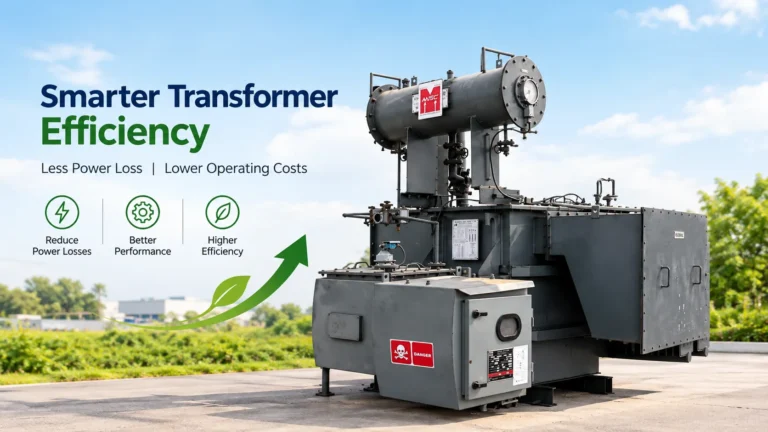
Transformers are essential to almost every industrial power system. From manufacturing plants and process industries to infrastructure and renewable energy projects, transformers help deliver electrical power at the voltage levels required for safe and efficient operation.
However, transformer efficiency directly affects the overall energy performance of an industrial facility. Even small increases in power losses can result in higher electricity consumption, increased operating costs and unnecessary heat generation over the life of the transformer.
Choosing the right transformer design, maintaining appropriate loading conditions and carrying out regular inspections can significantly improve performance. This is why working with an experienced transformer manufacturer in India is important when selecting transformers for industrial applications.
What Causes Power Losses in a Transformer?
Transformer losses are generally divided into two main categories: no-load losses and load losses.
1. No-Load Losses
No-load losses occur whenever the transformer is energized, even when there is little or no electrical load connected to it.
These losses mainly include:
- Core losses
- Hysteresis losses
- Eddy current losses
The quality and design of the magnetic core have a major influence on these losses. High-quality core materials and optimized magnetic circuit designs can help reduce energy consumption during continuous operation.
2. Load Losses
Load losses increase as the transformer carries more current. They are mainly associated with the resistance of transformer windings and other conductive components.
Load losses include:
- Copper losses in windings
- Stray load losses
- Additional losses caused by leakage flux
Since these losses increase with loading, selecting the correct transformer capacity is important for maintaining efficient operation.
7 Ways to Improve Transformer Efficiency
Improving transformer efficiency is not limited to the transformer itself. The operating environment, loading conditions, maintenance practices and overall electrical system also play important roles.
1. Select the Correct Transformer Capacity
One of the most important steps is selecting a transformer with the right capacity for the application.
An undersized transformer may operate continuously at high loads, increasing temperature and losses. On the other hand, an oversized transformer can result in unnecessary no-load losses and higher initial costs.
Industrial facilities should evaluate:
- Existing connected load
- Maximum demand
- Load growth
- Load diversity
- Operating hours
- Starting currents of large equipment
- Future expansion requirements
A properly sized transformer can operate closer to its optimum efficiency range without being unnecessarily overloaded.
2. Choose a Transformer with a Suitable Efficiency Profile
Transformer efficiency can vary depending on the design, capacity, loading and application.
Industrial users should evaluate both no-load and load losses when comparing transformer options rather than focusing only on the purchase price.
For applications where transformers remain energized for long periods, even relatively small differences in no-load losses can become significant over several years.
Experienced distribution transformer manufacturers in India can help customers select suitable designs based on the expected load profile and operating conditions.
3. Avoid Continuous Overloading
Operating a transformer above its rated capacity can increase winding temperature and accelerate insulation ageing.
High loading can also increase copper losses because load-related losses rise significantly with current.
Industrial facilities should monitor:
- Transformer loading percentage
- Winding temperature
- Oil temperature, where applicable
- Voltage levels
- Current on individual phases
- Load variations throughout the day
If a transformer frequently operates near or above its rated capacity, the facility may need load redistribution, additional transformer capacity or a different system configuration.
4. Maintain Proper Cooling
Heat is one of the major factors affecting transformer performance and service life.
Transformers need effective heat dissipation to maintain operating temperatures within acceptable limits. Depending on the transformer design, cooling may involve natural air circulation, radiators, fans, pumps or other cooling arrangements.
Industrial users should ensure that:
- Cooling equipment is functioning correctly
- Radiators are clean and unobstructed
- Ventilation around the transformer is adequate
- Cooling fans are inspected regularly
- Oil levels and condition are monitored where applicable
Poor cooling can increase operating temperature, accelerate insulation deterioration and reduce the expected service life of the transformer.
5. Maintain Transformer Oil and Insulation
For oil-filled transformers, transformer oil performs important insulation and heat-transfer functions.
Oil condition can change over time because of moisture, contamination, oxidation and prolonged thermal stress.
Regular testing and inspection can help identify developing problems before they affect transformer performance.
Depending on the transformer and application, maintenance programs may include checking:
- Oil dielectric strength
- Moisture content
- Acidity
- Visual condition
- Dissolved gas characteristics
- Oil level
- Leakage
Proper insulation maintenance helps maintain reliable electrical performance and reduces the risk of unexpected failures.
6. Maintain Balanced Electrical Loads
Three-phase transformers perform most efficiently when loads are reasonably balanced across the phases.
Significant phase imbalance can cause:
- Uneven current distribution
- Additional losses
- Increased heating
- Voltage imbalance
- Reduced equipment performance
Industrial electrical teams should periodically check phase currents and redistribute single-phase loads where necessary.
Maintaining a balanced system can improve transformer performance while also supporting the reliable operation of connected electrical equipment.
7. Monitor Transformer Performance Regularly
Transformer efficiency should not be treated as a one-time design consideration.
Regular monitoring can help industrial facilities identify changes in performance before they become major problems.
Useful parameters to monitor include:
- Voltage
- Current
- Load percentage
- Temperature
- Power factor
- Energy consumption
- Oil condition
- Abnormal noise or vibration
Modern monitoring systems can also provide useful operating data that helps maintenance teams identify trends and plan preventive action.
How Transformer Design Affects Energy Efficiency
Transformer construction and design have a direct impact on energy performance.
Important design considerations include the magnetic core, winding arrangement, conductor selection, insulation system, cooling method and overall electrical configuration.
For example, improvements in core design can help reduce no-load losses, while optimized winding design and conductor selection can help manage load losses.
This is one reason why selecting an experienced transformer manufacturing company is important for industrial projects. The transformer should be designed around the actual electrical requirements rather than selected only on rated capacity.
Distribution Transformers and Power Transformers: Efficiency Considerations
Both distribution and power transformers need to operate efficiently, but their operating conditions can differ.
Distribution transformers are commonly used to deliver electrical power at distribution voltage levels. Because they can remain energized for long periods, minimizing no-load losses is particularly important.
Power transformers, on the other hand, are generally used in higher-capacity transmission and industrial power systems. Their efficiency depends heavily on loading, voltage levels, cooling arrangements and application-specific design requirements.
For this reason, power transformer manufacturers in India must consider the complete operating profile when designing or recommending a transformer for a project.
Why Transformer Efficiency Matters for Industrial Plants
Improving transformer efficiency can provide several benefits beyond reducing electricity losses.
Lower Operating Costs
Reduced electrical losses mean less energy is wasted as heat, helping lower long-term operating costs.
Better Equipment Reliability
Lower operating temperatures can reduce thermal stress on insulation and other transformer components.
Longer Service Life
Proper loading, cooling and maintenance can help reduce premature ageing and extend transformer service life.
Improved Power System Performance
A well-maintained transformer supports stable voltage delivery and reliable operation of downstream equipment.
Reduced Environmental Impact
Reducing unnecessary energy losses also helps industrial facilities use electricity more efficiently and reduce avoidable energy consumption.
How MSC Transformers Supports Efficient Industrial Power Systems
MSC Transformers provides transformer solutions for industrial and commercial applications, with a focus on reliable performance, quality and application-specific requirements.
As a transformer manufacturer in Pune, MSC Transformers works with customers to provide transformer solutions based on factors such as capacity, voltage requirements, application, loading conditions and operating environment.
Its product range includes distribution transformers, power transformers, hermetically sealed distribution transformers, solar inverter duty transformers, furnace transformers and compact substations.
For industrial projects, selecting the right transformer is only one part of achieving long-term efficiency. Correct sizing, installation, commissioning, periodic inspection and appropriate maintenance are equally important.
MSC Transformers also provides transformer-related services including technical support, commissioning assistance, maintenance and after-sales support to help customers maintain reliable transformer performance.
Practical Transformer Efficiency Checklist
Before selecting or operating a transformer, industrial users should consider:
- Is the transformer capacity suitable for the actual load?
- Are no-load and load losses within acceptable limits?
- Is the transformer operating within its rated loading conditions?
- Is the cooling system functioning properly?
- Are transformer oil and insulation being monitored?
- Are three-phase loads reasonably balanced?
- Are voltage and current being monitored regularly?
- Is there sufficient capacity for future expansion?
- Is the transformer suitable for the installation environment?
- Does the manufacturer provide appropriate technical and after-sales support?
Addressing these factors can help industrial facilities reduce avoidable losses and improve transformer reliability.
Conclusion
Transformer efficiency plays an important role in the overall performance and operating cost of an industrial electrical system. Power losses cannot be eliminated completely, but they can be managed through appropriate transformer design, correct capacity selection, proper loading, effective cooling and regular maintenance.
Whether a project requires a distribution transformer, power transformer or specialized industrial transformer, the right equipment should be selected according to the application’s actual electrical and operating requirements.
Working with experienced transformers suppliers in India and manufacturers such as MSC Transformers can help industrial users make better decisions regarding transformer selection, installation and long-term performance.
For industries looking to reduce energy losses and improve electrical reliability, transformer efficiency should be considered from the initial design stage rather than only after operational problems occur.
Frequently Asked Questions
Transformer efficiency can be improved through correct transformer sizing, minimizing no-load and load losses, maintaining proper cooling, avoiding overloading, balancing electrical loads and carrying out regular inspections and maintenance.
The main transformer losses are no-load losses and load losses. No-load losses are primarily associated with the transformer core, while load losses are mainly caused by winding resistance and other effects that increase with electrical load.
Yes. As transformer current increases, load-related losses also increase. Continuous overloading can cause